Georgetown University 3-Week Summer Academies for high school students
Washington, United StatesGeorgetown University Summer Programs for High School Students
- Latest published dates
- Jun 7 – Aug 7, 2026
- Duration
- 20 days
- Ages
- 13–18
$3,028
Per week on a 3-week stay
Sold in packages from 3 weeks — $9,085
Global Business Academy
We'll let you know when this camp adds new dates.
Three-week Academies are intensive, non-credit courses for high school students on Georgetown University's main campus in Washington, D.C. The length is what lets each Academy work as a sequence rather than a survey: students in the medical Academy follow a first-year medical school curriculum in outline, and the policy, business and social justice Academies build towards a piece of work of their own — an assessed policy question, a case, a student organisation they have designed. Students choose one Academy and stay with the same faculty and group for the whole stay. Academic programming runs through the day and into the evening; residential students live in a university residence hall with supervised evening and weekend activities. Teaching is by Georgetown faculty and practitioners from the field, in the university's own lecture rooms and laboratories, with off-site visits across the capital — embassies, think tanks, museums and government offices among them.
Language
English
Program type
Science / STEM Camps
Accommodation
Campus
About
About the Course
Each Academy is a single, non-credit subject course taken for the whole three-week stay: students choose one Academy and stay with the same faculty and the same group throughout. Teaching mixes lectures, guest speakers from the relevant profession, guided discussion, small-group dialogue, simulations, group work and practical exercises with off-site visits in Washington. The three-week format is what makes the longer forms of work possible — a first-year medical school curriculum in outline in the Medical Immersion Academy, embassy visits and crisis simulations in Foreign Policy, and a project designed and presented by the student in the Bridges to Social Justice and the business Academies. Academic programming runs from mid-morning to the evening on weekdays. Instruction is in English and no credit is awarded.
What’s Included
Residential tuition covers the Academy itself, a room in a Georgetown residence hall and 19 meals per week in the campus dining halls, together with the evening and weekend student activities programme and residential supervision. Georgetown also sells each Academy on a commuter basis, at a lower published rate, which covers the academic programme only and includes neither housing nor meals; commuter students may buy a meal plan separately from Georgetown Dining. A non-refundable application fee applies and is waived for applications received by the school's Early Bird Deadline. International students pay a health insurance fee. Spending money, books and any laboratory fees attached to particular courses are not included.
Accommodation
Residential students live in a Georgetown University residence hall on the main campus, with residential life staff on site and a curfew. Georgetown does not publish the room occupancy for its high school Academies — how many students share a room is not stated anywhere on the programme pages. The room type recorded on this card is therefore a technical placeholder required by our catalogue, not a statement about the accommodation; we will confirm the actual arrangement with the university before any booking. Commuter students live at home and travel in for the academic day.
Meal Plan
Residential tuition includes 19 meals per week, eaten in Georgetown's campus dining halls alongside the university's own students. Commuter students are not covered for meals and can buy a meal plan directly from Georgetown Dining, chosen from the plans it offers. The neighbourhood immediately around campus has a wide range of places to eat, including vegetarian options.
Activities & Excursions
Beyond the academic day, students join an organised programme of evening and weekend activities: film screenings on the lawn, campus social events, arts and music, athletics and college-readiness sessions. Because the campus sits in the middle of Washington, much of the programme happens off campus — museums, the monuments, the Capitol and other sites in the city, which double as teaching visits for several Academies. Participation in the evening programme is optional, and there is free time before curfew.
Facilities
Academies are taught in Georgetown's own lecture rooms and laboratories on the main campus, the same spaces its undergraduates use. Medical and nursing students work in the O'Neill Family Foundation Clinical Simulation Center with a lifelike patient simulator. Residential students use the university residence halls and the campus dining halls, and the campus itself runs down to the Potomac, where the university's crews row.
Camp Experience
The Academies are built to feel like a first taste of university rather than a summer camp: students live in a hall of residence, eat in the dining halls, are taught by Georgetown faculty and practitioners, and work in a group of peers who chose the same subject. The setting does a lot of the work — Washington means the people who make policy, practise law or treat patients are a short journey away and turn up as guest speakers. Students leave with a finished piece of work, a view of one profession from the inside and a realistic sense of what a university course in it demands.
Language Camp prices
Global Business Academy
20 Lessons · 13–18 yrs · B2–C22026 price
Although there is an underlying universality to the basic principles of business, the application of these principles presents unique challenges to those involved in international business. The Global Business Academy is designed to provide a comprehensive and up-to-date overview of global business. In the program, you'll explore current drivers of international business including the globalization of business linking markets, companies, and financial markets; the growth and importance of technology; and the emergence of national economies. You'll also examine institutions important in international business including the World Bank, the International Monetary Fund, and the World Trade Organization.
Academic programming runs between 9:00 a.m. and 9:00 p.m. on weekdays. A typical weekday: breakfast 7:00–9:00 a.m.; lecture, off-site visit or lab 9:00 a.m.–12:00 p.m.; lunch 12:00–1:30 p.m.; lecture, off-site visit or lab 1:30–5:00 p.m.; dinner 5:00–7:00 p.m.; capstone project work 7:00–9:00 p.m.; student activities and residential life supervision 9:00–11:00 p.m. After the academic day, students may join optional cocurricular events, free time and residence-hall activities until curfew.
Class sessions, field trips, hands-on workshops, group discussions and extracurricular activities. Subject areas published by the school: current drivers of international business; how globalization of business links markets, companies and financial markets; the emergence of national economies; institutions important in international business; importance of technology.
Daily Schedule
Breakfast
07:00–08:00
Classes
08:30–12:30
Lunch
12:30–13:30
Dinner
18:30–19:30
Evening activities
20:00–22:00
Lights out
22:30
Included items
Optional Extras
Photos
School

Georgetown University Summer Programs for High School Students
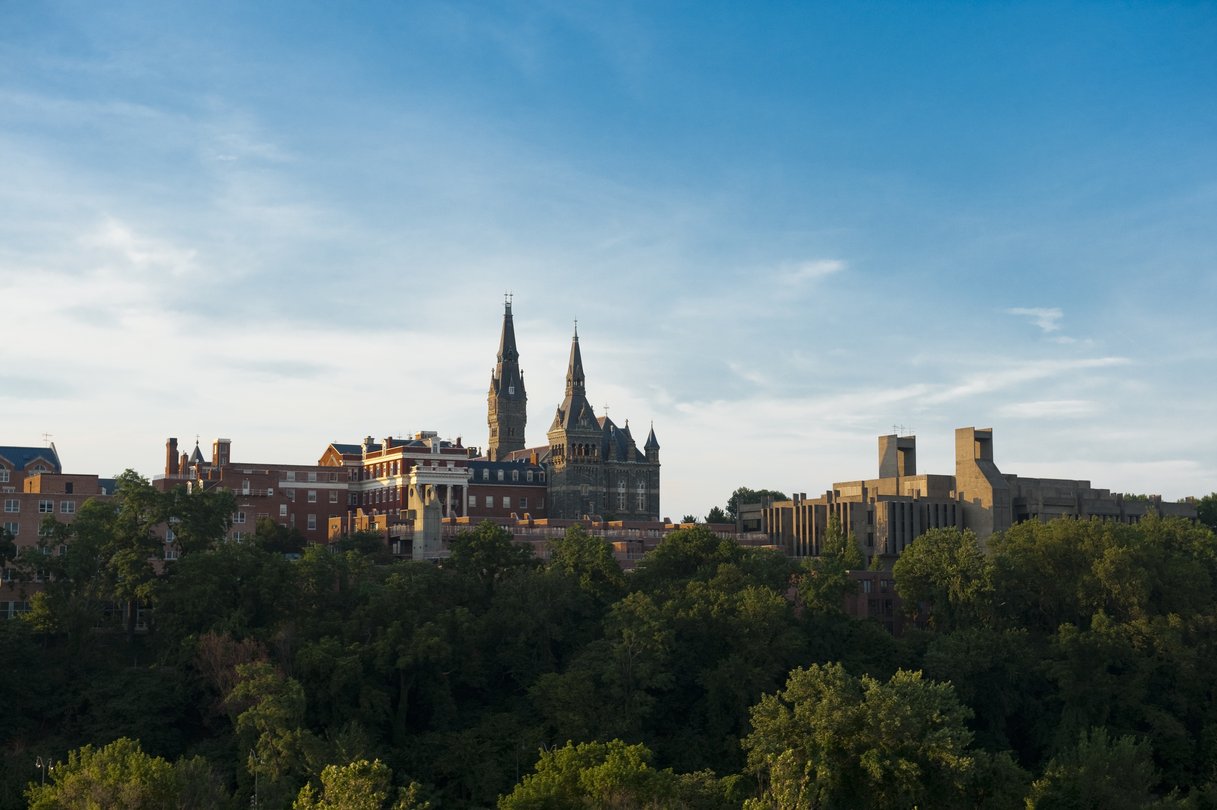
Georgetown University runs its summer programs for high school students through the School of Continuing Studies, on the university's main campus in the Georgetown neighbourhood of Washington, D.C. The programmes are taught by Georgetown faculty and practitioners, and students live in university residence halls, eat in the campus dining halls and use the same lecture rooms, libraries and laboratories as undergraduates. The pre-college offer is built around short, subject-focused Academies in fields such as international relations, law, medicine, nursing, forensic investigation, artificial intelligence, business and creative writing, alongside credit-bearing university courses taken with undergraduates. Days combine lectures, guest speakers, guided discussion and hands-on project work with off-site visits across the capital, and residential students have a supervised evening and weekend programme. Applications, tuition and payment are all handled by Georgetown University itself.